
This is part 1 in a series on how I used LLMs to do reliable financial research
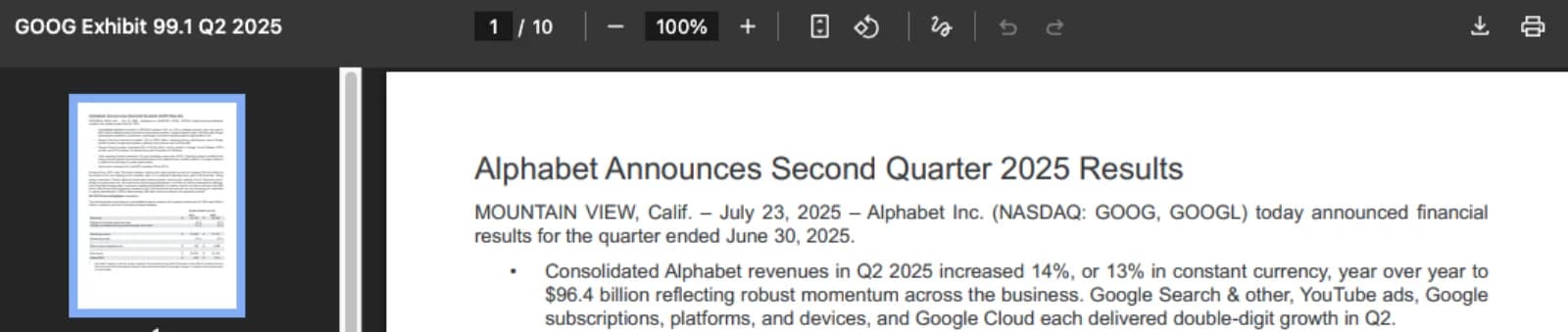
LLMs are incredibly good at summarizing documents, so I, and presumably many other investors, use ChatGPT or Claude to summarize earnings releases.
I found that LLMs capture interesting-seeming information but miss boring details I wouldn't miss. How did I figure out which details matter?
I correlated LLM-generated summaries of all S&P 500 earnings releases against high quality forecasts to see what was useful. I took the top 50 most forecast-relevant releases and found these patterns.
What I Found
- I found LLMs gravitate toward CEO quotes, vision statements, and product launches, which rarely helped my forecasts
- LLMs omit seemingly boring info that I would flag as important, in five categories below
- I needed to pass specific context and prompt carefully. I explain what worked for me at the end.
What I Never Want To Miss in Earnings Releases
Pattern 1: Segment Divergence - When Headlines Hide Reality
I found the most valuable information is when top-line growth masks segment-level deterioration, or when strong margins hide collapsing volumes. This divergence appears first in earnings releases because they combine current-period actuals with segment detail, and by the time the 10-Q is filed, the market has moved.
I read these right when they come out. If I had to wait, I'd pass the 10-Q in as context.
I found this in 34 of 50 companies.
Example: AppLovin (APP)
Q2 2025 release revealed 81% adjusted EBITDA margin—exceptional tech company profitability achieved while growing 77% YoY. The critical detail buried in segment breakouts: this came after divesting the Apps business, transforming from a mixed model to pure-play ad-tech. The release quantified this with specific margin progression, showing the business model had fundamentally changed. This wasn't just "good results"—it was evidence of a structural shift warranting complete revaluation.
Example: UnitedHealth (UNH)
Q2 2025 showed Medical Care Ratio spiking to 89.4%—a 430bp deterioration. The release specified this wasn't broad-based but concentrated in Medicare Advantage with a "significant gap of ~250 basis points between costs and pricing" and costs expected to accelerate to "nearly 10%" in 2026. This quantified divergence revealed systemic mispricing that would take years to correct, fundamentally altering 5-year margin forecasts.
Example: Starbucks (SBUX)
North American operating margin collapsed from 21.0% to 13.3%, but the critical detail was in volume breakdown: transactions down 3% despite price increases. This revealed the company had broken its value proposition—customers weren't just delaying purchases, they were rejecting the offering entirely.
Pattern 2: Capital Deployment - Actions Over Words
I found that changes in capital allocation, especially when contradicting stated strategy, prove remarkably predictive of management's true confidence in the business. Capital allocation changes appear in releases before strategic rationale is fully explained. Management can spin strategy in calls, but cash deployment reveals true priorities.
I found this in 29 of 50 companies.
Example: Builders FirstSource (BLDR)
Q2 2025 release revealed $391 million in buybacks—nearly 5x the combined spending on acquisitions and organic growth, representing 48.1% of shares retired since 2021. This signaled management believed the stock was deeply undervalued despite a weakening housing market. Aggressive buybacks during cyclical downturn proved the strongest signal of long-term confidence.
Example: C.H. Robinson (CHRW)
After running 82-83% payout ratios, the company completely suspended buybacks in Q2 2025. The release's absence of buyback activity signaled management's pivot from capital return to balance sheet repair before it was explicitly stated, foreshadowing the strategic review announced later.
Example: Verisk (VRSK)
The $2.35 billion AccuLynx acquisition announced in the release represented ~7% of market cap, fundamentally changing growth strategy from organic data sales to platform expansion. The size of the bet signaled management's view that the core business needed transformational growth drivers.
Pattern 3: Guidance Mechanics - Structure Over Numbers
It's not in the guidance itself, but how guidance is constructed reveals management's confidence, visibility, and priorities. What's excluded or heavily qualified often matters more than what's included.
I found this in 27 of 50 companies.
Example: Tesla (TSLA)
Q2 2025 guidance excluded China revenue from restricted AI chips entirely while projecting overall growth. This revealed management's confidence that non-China business could offset major geographic headwinds—critical for long-term forecasting since it showed the business wasn't dependent on any single market.
Example: Take-Two (TTWO)
Fiscal 2026 guidance called for $377-442 million net loss despite strong current results. The release specified this loss was "strategic investment" ahead of GTA VI launch. The magnitude revealed management was front-loading costs rather than spreading them, signaling extreme confidence in the franchise.
Example: Centene (CNC)
Complete withdrawal of numerical guidance in Q2 2025 and shift to qualitative statements signaled management had lost visibility into cost trends—far more alarming than a simple guidance cut. The release stated management would provide "2025 earnings expectations during the earnings conference call" rather than in writing, revealing they couldn't commit anything to paper.
Pattern 4: Quantified Strategy - Specifics Beat Spin
I find that when earnings releases quantify strategic shifts with numbers, that's way more useful than qualitative fluff. Strategic pivots are cheap talk until quantified.
I found this in 23 of 50 companies.
Example: Amcor (AMCR)
The release identified exactly "$2.5 billion in non-core businesses for potential divestiture" including "the entire $1.5 billion North America Beverage business." This specificity allowed precise forecasting of future portfolio composition and margin structure, versus vague "portfolio optimization" language.
Example: APA Corporation
The release specified "25% rig count reduction while maintaining flat production guidance and cutting Permian capital by $130 million." These three specific metrics quantified efficiency gains better than any strategic narrative. The math revealed: 25% fewer rigs + flat production = 33% productivity improvement per rig—sustainable competitive advantage.
Example: Baker Hughes (BKR)
"$650 million in year-to-date data center awards" and "nearly 1.2 gigawatts of turbine capacity" gave specific evidence of the data center pivot's traction, versus competitors' vague AI positioning statements.
Pattern 5: One-Time Costs Are Strong Signals
Finally, I find certain one-time charges, settlements, or gains often reveal far more about underlying business quality than management acknowledges. Non-recurring items are often dismissed as noise, but their specific causes reveal operational vulnerabilities or dependencies that affect long-term forecasting.
I found this in 19 of 50 companies.
Example: AMD
The $800 million inventory charge on MI308 chips due to export controls appeared first in the release with specific quantification. This wasn't just a one-time item—it revealed acute supply chain and geopolitical risk that would persist for years.
Example: Universal Health Services (UHS)
$101 million in supplemental Medicaid payments appeared as "not part of original forecast." This revealed dependency on state funding programs about to be cut by federal legislation, foreshadowing major revenue headwind.
Example: Disney (DIS)
The $3.3 billion tax benefit from Hulu reclassification appeared prominently, but the release also buried "difficult theatrical comparisons" due to prior-year hits. This foreshadowed earnings volatility in the content business that would persist.
What I Want LLMs to Ignore
I don't even look at information in these five categories anymore. LLMs love this stuff, but it never helps:
1. CEO Quotes & Strategic Vision
I saw this in every company, but it only mattered in maybe 8. Management's qualitative assessment rarely tells me anything the numbers don't. "We're pleased with results" and "focused on executing our strategy" add zero information—these sections exist for legal compliance and PR, not analysis.
Exception: First-time mentions of specific challenges or changes in tone (e.g., moving from "confident" to "monitoring challenges"). To get this, I'd pass the previous earnings releases into the context window.
2. Market Share Claims
Companies are creative about defining markets to claim leadership. "Leading provider of X in Y geography among Z customer type" is usually cherry-picked. These look substantive to LLMs but tell me nothing.
3. Product Announcements
"Launching new product X" doesn't tell me anything without pricing, market size, revenue contribution, and competitive positioning. I need numbers. LLMs think these announcements are critical, but they rarely matter.
4. Partnership/Customer Testimonials
Directionally positive but rarely material to forecasts unless quantified with contract values, exclusivity terms, and revenue impact timelines.
5. Y/Y Comparisons Without Context
"Revenue up 15% vs. prior year" doesn't tell me much without knowing: Was there an acquisition? What was the prior year comparison? What's the sequential trend? What's the organic vs. inorganic split? I pass in background documents if I want the LLM to include this context. Otherwise I tell the LLM to ignore it.
My Recipe
You might expect me to recommend breaking this into many queries. Actually, I found LLMs are smart enough with long context that one good prompt works, if you're using a frontier model as of late 2025.
Here's what I pass as context:
I find that 10-Q, 10-K, last quarter's release, and other basic financials (industry growth rate, industry news) all help. See the bottom for links to my other pieces on how to get and extract insight from these documents without flooding the context window.
Here's the language I use for each category:
For segment divergence, I use:
Extract all segment-level financial metrics from this earnings release.
For each segment, provide:
- Revenue ($ amount and YoY % growth)
- Operating income/margin (if disclosed)
- Key operational metrics (customers, volumes, etc.)

Flag any divergence where:
- Growth variance >10 percentage points between segments
- Margin variance >200 basis points between segments
For capital allocation, I use:
Extract all capital allocation activities from this earnings release:
- Share repurchases ($ amount, shares, avg price if disclosed)
- Dividends ($ amount per share, any changes vs. prior)
- M&A announcements (deal size, target, financing)
- Debt paydown or issuance ($ amount, terms)
- CapEx ($ amount, any changes vs. guidance)

Flag changes where:
- Buybacks changed >25% quarter-over-quarter
- Any new capital allocation activity appears
- Any stated capital allocation activity is absent
- Stated strategy contradicts actual deployment

List contradictions between stated strategy and actual capital deployment.
For guidance mechanics, I use:
Do NOT summarize the guidance numbers. Instead, analyze the guidance structure:

1. What specific metrics are included in guidance?
2. What metrics were guided previously but excluded now?
3. What new metrics appear in guidance that weren't there before?
4. What qualifications or contingencies are mentioned? ("excluding," "adjusted for," "subject to")
5. What's the format? (specific number, range, qualitative only)
6. What's the language? ("expect," "target," "anticipate," "committed to")

If the prior earnings release(s) are included, flag any changes.
For quantified strategy, I use:
Extract ONLY statements that contain specific numbers about operations. Include:
- Customer counts, growth rates, retention rates
- Volume metrics (units sold, subscribers, transactions)
- Pricing metrics (ASP, yield, price increases/decreases)
- Operational metrics (stores, rigs, capacity, utilization)
- Efficiency metrics (cost per X, revenue per Y)

Ignore:
- Any statement without a specific number
- Percentages without underlying base amounts
- Vague quantifiers ("significant," "strong," "increased")
- Strategic language without quantification
For one-time costs, I use:
Identify all non-recurring items mentioned in this release:
- Restructuring charges
- Impairments or write-downs
- Legal settlements
- Tax benefits/charges
- Gain/loss on asset sales
- Unusual regulatory payments or refunds

Skip those representing <5% of quarterly earnings. For those above:
1. What is the item? ($ amount)
2. What caused it? (be specific)
3. What does this reveal about the business?
   - Strategic failure? (impairment of acquired assets)
   - Operational vulnerability? (litigation, cybersecurity breach)
   - Hidden dependency? (regulatory payments, one-time tax benefits)
   - Balance sheet cleanup? (accelerated write-downs)
Further Reading: Earnings Release vs other documents
This is the first piece where I explain how I use AI to read financial documents. Here's what's unique about earnings releases versus other documents:
Earnings Releases vs. 10-Ks/10-Qs
Earnings releases give me current results, management response, and guidance all at once. I can spot disconnects before the 10-Q comes out with more detail.
The 10-K discusses strategy; the 10-Q provides comprehensive numbers. But earnings releases uniquely capture the immediate collision between strategy and operational reality. By the time the 10-Q is filed (30-45 days after quarter-end), the market has already moved on the earnings release information.
Earnings Releases vs. Earnings Calls
Numbers in the release are fixed; management explanation comes after in the call. The release shows what happened; the call explains why it happened.
Management can frame narrative in the call ("we're investing for the future," "temporary headwinds," "strategic pivot"). But the release has already quantified the magnitude of underperformance, capital allocation shifts, or guidance changes. The facts are locked in before the spin begins.
Companies that provide segment-level detail make my job way easier. Companies that bury this information either have something to hide, don't understand their business, or prioritize legal protection over transparency.