
Value investors understand that accurate stock valuations require forecasting cash flows over 10+ years. Here we apply that discipline to Delta Air Lines, leading to a surprising conclusion.
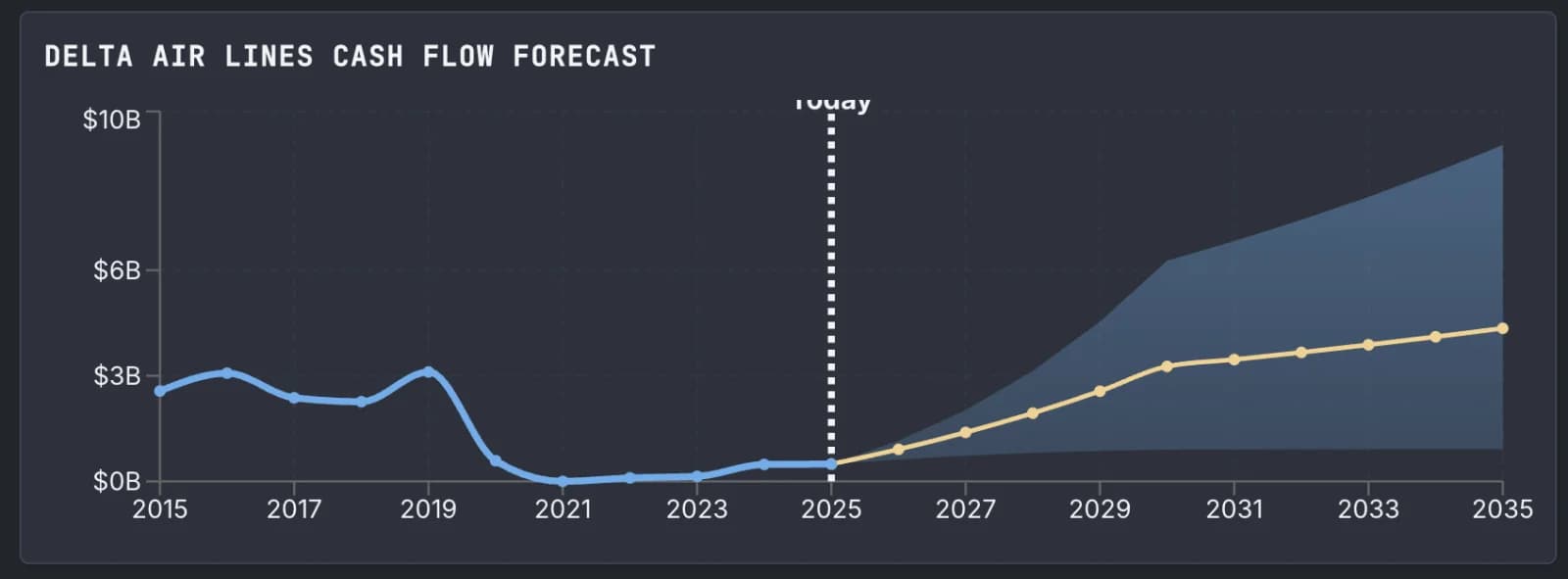 Historical cash flows collapsed from $3B to near-zero during pandemic with projected recovery to $4.5B+ annually by 2035
Summary
- We show the results of our long-term fundamental analysis of Delta, projecting it returns approximately $3 billion annually to shareholders by 2030, a huge turnaround on the last 5 years
- We model 2030 revenue of $81 billion with 8% net margins, reflecting Delta's transformation into a premium-focused airline with 59% of revenue from high-margin streams
- To stress test this forecast, we analyize structural headwinds including sustainable aviation fuel mandates, labor inflation, and the loss of the Aeromexico joint venture to stress-test this forecast
After examining a decade of financial history, assessing management's track record, and modeling the company's evolution through 2030 to project long-term returns to shareholders, we find a striking conclusion:
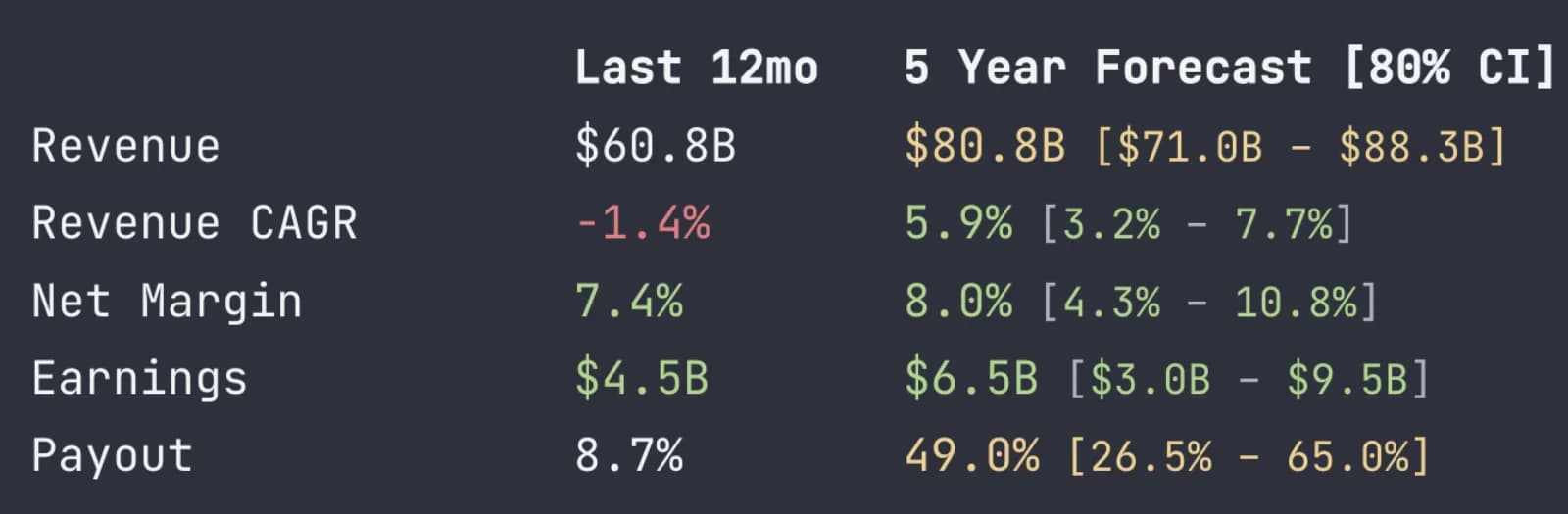 Five-year forecast projects nearly 50% payout ratio by 2030, a dramatic inflection from today's near-zero capital returns
Delta is positioned to return approximately $3 billion annually to shareholders by 2030 through dividends and buybacks. That single year would exceed the combined capital returns from the entire 2020-2024 period, representing a fundamental inflection in the company's ability to generate and distribute cash.
This isn't speculation about near-term stock movements. It's our methodical forecast based on Delta's business model transformation, anchored in financial statement analysis and tempered by realistic assumptions about management execution and industry headwinds.
Here we summarize the core line of reasoning which leads to our valuation.
The Magnitude of the Reset
We first notice dthat Delta's trailing twelve-month dividends and share repurchases total just $8.7 million, basically nothing for a $60B revenue compaany. This may be the most compressed capital return period in modern airline history.
And it's surprising too. In the years before COVID-19, Delta maintained a payout ratio around 61%, returning substantial cash to shareholders through a combination of dividends and aggressive buyback programs. The pandemic forced a complete reset as the company focused on liquidity preservation and debt management.
It seems to use that recovery has been gradual, yet is very likely to return to complete normalcy. The company has begun modest dividend payments and recently authorized a share repurchase program. Yes, execution remains constrained by debt reduction priorities. But management has stated clear leverage targets and a balanced capital allocation framework that means more free cash flow will shift toward shareholder returns.
These early moves give us confidence in the earnings trajectory. The real question is whether Delta can generate sufficient and sustainable cash flows to support meaningful capital returns. That question requires examining the fundamental transformation in how Delta makes money.
A Business Model Transformation
Forecasting Delta's long-term cash flows requires understanding a fundamental shift in its revenue composition. 59% of revenue now comes from premium products, loyalty programs, cargo, and maintenance services rather than basic economy tickets. This is a structural change from how the airline used to generate profits.
See for example the American Express partnership. Research into Delta's 2024 10-K filing shows the SkyMiles loyalty program and co-brand credit card partnership generating approximately $7-8 billion annually in remuneration from American Express, roughly 12% of total revenue. This revenue stream has consistent growth across multiple years, even through periods of industry stress. The Q2 2025 earnings call transcript reveals management's emphasis on record card spending and continued partnership momentum.
Premium cabin products show similar durability. While main cabin sales were essentially flat in 2024, premium products grew 8% according to the company's annual report. The Q2 2025 10-Q filing continued this trend, with premium revenue growth significantly outpacing the overall business. This divergence matters enormously for forecasting purposes.
The maintenance, repair, and overhaul (MRO) business is another emerging revenue stream. The above earnings call indicates management targeting this segment to scale into a $1-3 billion business, diversifying cash flows.
For long-term forecasting, these high-margin revenue streams provide stability that traditional ticket sales cannot. They're less vulnerable to economic cycles, competitive capacity additions, and fuel price volatility. They represent a floor under earnings that fundamentally changes Delta's cash flow profile relative to historical airline economics.
The 2030 Forecast Framework
Long-term valuation requires depends on three core variables: revenue growth, profitability, and capital allocation. Our forecast methodology examined Delta's historical performance across multiple business cycles, assessed base rates for the airline industry, and evaluated company-specific strategic advantages and risks.
Our median revenue forecast of $80.75 billion for 2030 represents a compound annual growth rate of approximately 4.5% from the 2024 base of $61.6 billion. This projection sits deliberately between the long-term industry growth rate of 3-4% and Delta's own historical performance, which showed 4.7% CAGR from 2015-2024. The positioning reflects Delta's premium strategy providing above-industry growth, tempered by the inherent cyclicality of airline revenue and headwinds including the regulatory termination of the Aeromexico joint venture, which could compress margins by 20-30 basis points.
Our net margin forecast of 8% for 2030 reflects a careful balance of competing forces. Delta's pre-pandemic net margins averaged approximately 10%, while post-recovery margins have averaged closer to 6.8%. The current quarter shows operating margins of 13.2%, demonstrating near-term operational strength. However, the forecast explicitly incorporates new structural cost pressures absent from historical periods.
Analysis of regulatory developments and industry trends indicates sustainable aviation fuel mandates could compress margins by 100-200 basis points by 2030. Labor cost inflation remains persistent across the industry. The Monroe refinery segment, originally positioned as a fuel cost hedge, has underperformed expectations with operating income collapsing 90% in 2024 according to our 10-K analysis.
These headwinds prevent a return to peak pre-pandemic margins, even as the premium revenue mix provides structural advantages. The 8% net margin forecast thus represents meaningful improvement from current levels driven by high-margin revenue growth, while remaining conservative relative to historical peaks.
Revenue of $80.75 billion combined with 8% net margins produces projected earnings of approximately $6.5 billion in 2030. The payout forecast of 49% translates to roughly $3.2 billion in annual capital returns through dividends and buybacks. This assumes free cash flow conversion typical of mature airlines and capital allocation priorities shifting toward shareholder returns as leverage targets are achieved.
Management Credibility and Conservative Assumptions
Do we model that management will deliver what they say? We calibrate our views based on how management has performed historically.
We give Delta a management reliability percentile of just 35%, meaning most S&P 500 managers have a better track record of following through than Delta's. Specifically, the company's 2024 operating margin fell short of management's own target by 35-40%—a substantial miss given the guidance was set in late 2021 when recovery trends were clearly visible. The shortfall was partly driven by specific internal factors, including the 90% collapse in operating income from the Monroe oil refinery.
Delta exceeded debt reduction targets and achieved investment-grade status. We account for this by avoiding aggressive assumptions and positioning projections in the middle of historical ranges rather than at optimistic endpoints.
The 49% payout ratio represents measured normalization rather than a return to pre-pandemic practice. Historical analysis shows Delta's pre-pandemic payout ratio was approximately 61%, reflecting the industry's aggressive capital return posture before COVID-19. Our forecast assumes Delta maintains greater financial conservatism going forward, consistent with post-pandemic industry practice and the company's stated balanced capital allocation framework.
In the Nov 2024 Investor Day, management laid out articulated a clear path: reducing gross leverage to 1.0x over the medium term, with capital allocation split between business reinvestment and shareholder returns. Only as the company approaches its 1.0x leverage target will the full weight of free cash flow shift toward dividends and buybacks. Our 49% payout forecast assumes Delta reaches its balance sheet targets by 2027-2028, allowing increased capital returns in the final years of the forecast period while maintaining conservative debt levels.
The Probability Distribution of Outcomes
Our long-term forecasts are probability distributions, not single-point predictions. Our median forecast of $3.2 billion in annual capital returns by 2030 represents the center of a range that acknowledges genuine uncertainty about economic conditions, competitive dynamics, and execution over a six-year horizon.
The 10th percentile scenario of $2.65 billion in annual returns assumes economic headwinds, greater margin compression from fuel and labor costs, and slower-than-expected premiumization. This scenario reflects the reality that airlines remain cyclical businesses. A recession could trigger sharp revenue declines and force capital allocation priorities back toward balance sheet preservation.
The 90th percentile of $4.2 billion envisions sustained economic growth, successful execution of the premium strategy, and earlier-than-expected achievement of leverage targets. In this scenario, Delta's structural advantages in loyalty and premium products drive both faster revenue growth and better margins, while strong cash generation enables more aggressive capital returns while still maintaining financial discipline.
The wide confidence interval reflects the inherent uncertainty in forecasting any business this many years forward.
The Results
Traditional stock analysis focuses on next quarter's earnings or applies simple multiples to near-term results. But accurate valuation requires forecasting cash flows over 10+ years and discounting them to present value. This is what Finance 101 teaches, yet it's effectively never practiced because of the difficulty of actually forecasting outcomes.
We hope the summary of our forecast here gives credence to the view that this forecasting is tractable. And most importantly, discounting cash flows far into the future provides a completely differentiated way of valuing companies.
In this case, summing discounted cashflows results in a total valuation significantly higher than Delta Air Lines' market cap, with the detail in the full forecast at stockfisher.app:
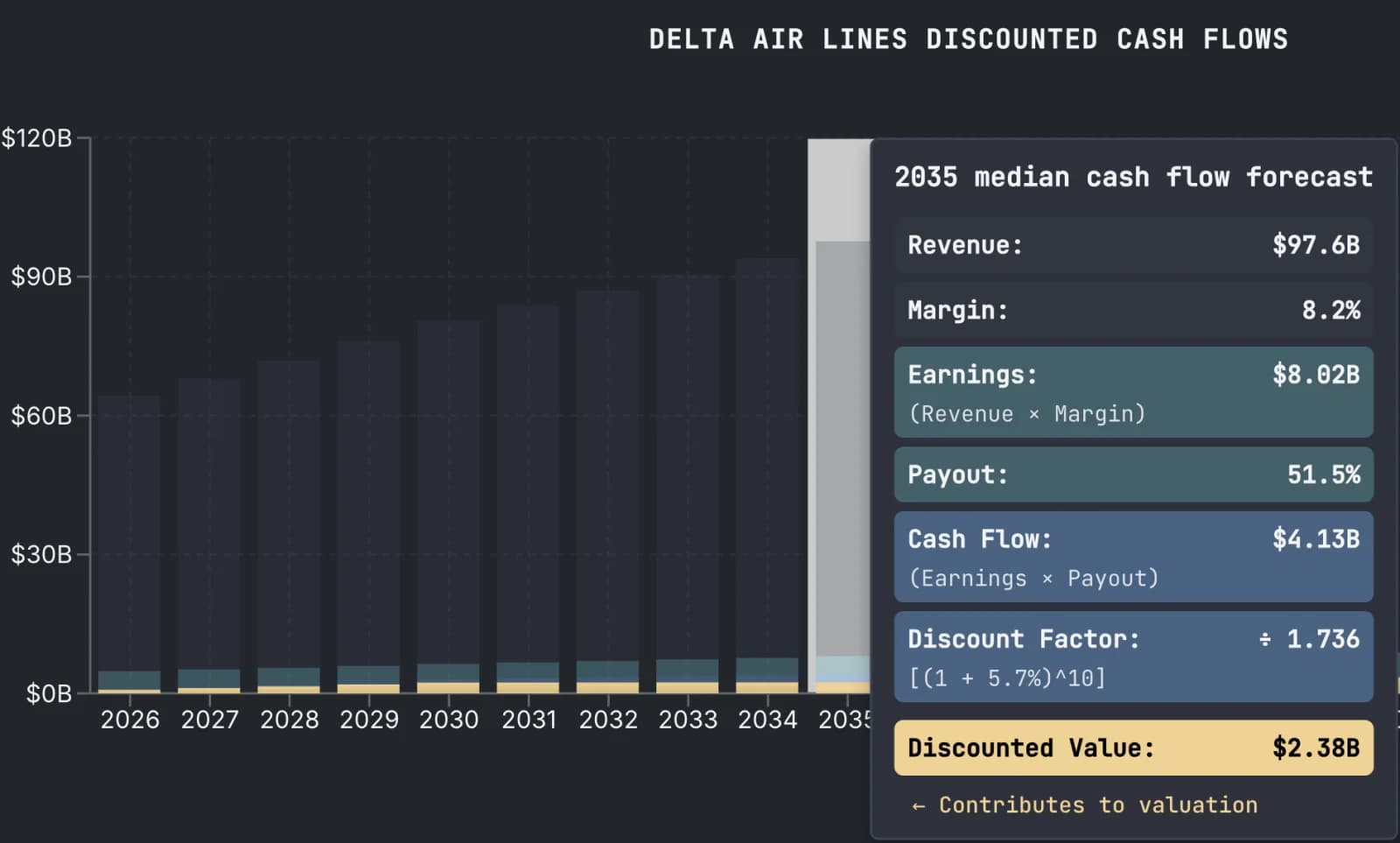 10-year discounted cash flow analysis showing gradual ramp in shareholder returns through 2035
For value investors willing to look beyond quarterly noise and focus on 10-year cash flows, this type of analysis reveals opportunities the market may be mispricing. The question isn't whether Delta will hit these precise numbers, but whether the market is adequately valuing the high probability of a dramatic cashflow turnaround over the next five years.