
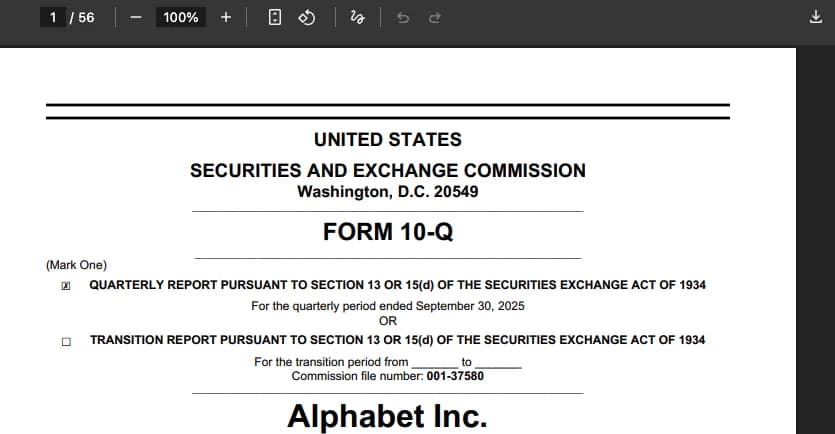
This is part 4 in a series on how we used LLMs to do reliable financial research. Dan wrote about earnings releases and 10-Ks. I wrote about earnings calls. This piece covers 10-Qs.
First, a quick refresher on methods. We used LLMs to extract findings from a number of financial documents for every company in the S&P 500. We then correlated their contents with what was most relevant in our final forecasts of company outcomes.
10-Qs played a big part here, as they are quarterly, with more recent than annual filings like 10-Ks. And companies are required to disclose certain things. Our problem, like with other doucments kinds, is that LLMs miss certain things we wouldn't miss reading them ourselves. And LLMs include things that are superficially interesting, but useless for our forecasting.
At a glance, here's what I found useful, and what I would encourage you to direct LLMs to look for when you ask them to read 10-Qs:
- Focus on the most recent things. Almost by definition, this is what a 10-Q will have, that the most recent 10-K will not.
- Look for unit economics, especially changes in margins. Margins are critical to our forecasts, so even small changes an LLM may ignore may be fundamental.
- Dollar impacts that management must quantify, especially when they'd rather not. There are all sorts of risks in 10-Qs, and I found it most valuable to only focus on those with large dollar amounts. (We found this also with 10-Ks and earnings releases.)
And of course, if a company is undergoing something big, the 10-Q is often the main source of truth. But LLMs will naturally pick up on that anyway so it isn't that important to push them to notice this.
What most changed my forecasts in 10-Qs
I rank these from most important to least important. (And again this is not what LLMs normally do if you simply ask them to summarize a 10-Q. they aren't very good at figuring out what matters the way an expert reader of these documents can.)
1) Margin Inflection Points
Our forecasts are all about growth rates. Margins having recently increased or decreased mean a lot to our 5-year forecasts. I frequently saw something in a 10-Q that led to a 2-4% change to 2030 net margin, which can change our valuations by billions.
Examples:
Supermicro (SMCI)
Gross margin declined from ~15.5% to ~9.6% YoY; sequential trend showed deterioration, not a one-off.
Stryker
MedSurg operating margin expanding to ~28% signaling durable operating leverage.
Amphenol
Comms Solutions ~30%+ operating margin vs. 25% historical; AI infrastructure pricing power.
2) Deal Timings
Previously we wrote about how deals announced in press releases rarely include purchase price adjustments, integration costs, etc. 10-Qs do, and while they may look like minor details, it's critical an LLM notice these.
Examples:
TKO Group
IMG close date and margin mix shift (UFC/WWE vs. IMG) re-weighted consolidated profitability.
Tapestry
Capri break fees shifted capital allocation to immediate buybacks.
Boeing
Spirit AeroSystems economics detailed, including liquidity support already advanced.
3) Regulatory Developments with Dollar Amounts & Dates
This is a repeat finding from all other types of documents. Lawsuits are very common in filings. We found ones with big dollar amounts were the ones that mattered. And they need to resolve soon to update our 2030 numbers. Most lawsuits don't move forecasts more than 1-2%. (Sometimes billion dollar lawsuits are actually not a big percentage of earnings - looking at you Google and Meta.)
Examples:
Applied Materials
Export rule impacts quantified into backlog and guidance dependency.
AEP
New state mechanisms (e.g., HB 5247) and FERC items with precise effective dates and dollars.
UHS / Amgen
Federal programs & Medicare price setting translated into modeled headwinds by year.
4) Geographic Divergence
Most of these pieces we've written point out that divergence matters more than averages. One more specific thing we think LLMs should pick out is when geographies are showing different revenues or margins. Seeing that change in the last quarter can signal some important underlying trend that changes the macro forecast, like something with China.
Examples:
Uber
EMEA +31% vs. US/Canada +13% growth; mix shift improved long-term margin quality.
Tyson / Valero / Tesla
Large spreads in segment margins forced re-weighting of what "drives" the consolidated story.
Two Teslas in one line item: Energy widens while Auto compresses. This is exactly what generic summaries skip.
Source: Tesla, Inc., Form 10-Q for the quarter ended September 30, 2025
5) Customer/Supplier Concentration Crossing Thresholds
Managers have to discloser things that exceed certain thresholds, like 10%. So a number like this can be very important because it may have been previously undisclosed. An LLM may not know that and gloss over a boring number that we actually think is really significant.
Examples:
Supermicro
One customer ~46% of receivables; a single supplier ~68% of purchases.
Trade Desk
Receivables concentration across a small number of clients flagged near-term cash collection risk.
6) Cash Flow Inflections
This is generally not subtle and LLMs generally notice this. Still, it is possible for humans to spot these things and LLMs to omit or misunderstand them in their summaries.
Forecast effect: 15–25% adjustments to "true" earnings power in DCFs; re-rating of growth that consumes cash.
Examples:
Boeing
Negative operating cash flow despite revenue growth reveals an earnings quality question, not a timing quirk.
Uber / Altria
Strong OCF/FCF runs confirming fundamentals versus optics.
Prompts
Unlike 10-Ks, we do think 10-Qs can probably be completely understood by an LLM in a single prompt, if you use the right LLM.
In this case, it can be useful to pass the most recent 10-K into th prompt. This way the LLM won't output stuff that is already well known and is elsewhere in our pipeline.
Analyze this 10-Q for forecasting value. Extract only things that are not in the 10-K included here. Focus on:

(1) Q/Q segment and margin changes with numbers
(2) Quantified one-time items (tax, legal, deals)
(3) Regulatory items with dates/amounts
(4) Customer/supplier concentration >10% and its trajectory
(5) Cash-flow & working-capital deltas
(6) Near-term guidance contingencies
(7) Anything that contradicts the 10-K or the prior quarter

For each finding: quote the number, explain how it changes 2026–2030
assumptions, and note exactly what wasn't in the 10-K.